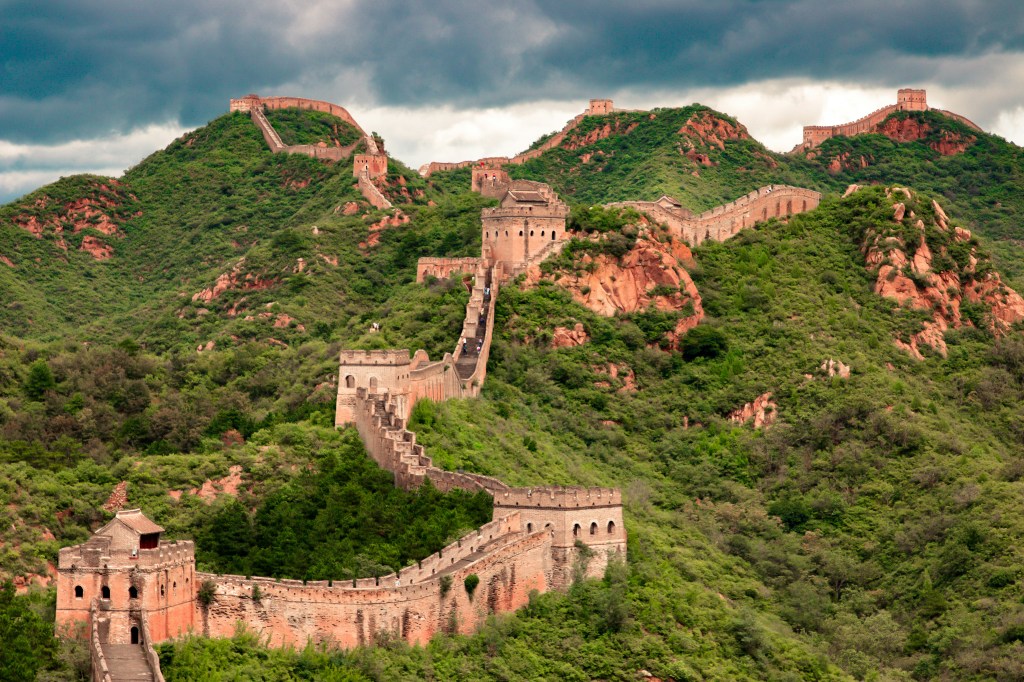
When you look at the Great Wall of China or the Terracotta Army—both UNESCO World Heritage Sites—have you ever wondered who built them? Well, today we’re gonna talk about him: the first emperor of China, Qin Shi Huang.
In the last video, I mentioned that China wasn’t one country 2,500 years ago. The Warring States Period was the most chaotic era, with centuries of conflict and bloodshed. By the end of it, only seven major states remained, fighting for dominance. Spoiler alert: the state of Qin won the war, united China for the first time, and its leader, Qin Shi Huang, became the first emperor.
While he was definitely an extraordinary military leader, in this video I want to focus on what he did beyond the battlefield—the things that profoundly shaped China.
Once in power, Qin Shi Huang didn’t just stop at unifying the land—he wanted to unify its people. He standardized currency, weights and measures, roads and axle widths, and most importantly, even the written language. (This is how Chinese characters looked back then. Should I make a video on the evolution of Chinese characters?)
Fun fact: he couldn’t change the spoken language because it was too difficult. After Qin Shi Huang, there were multiple attempts in Chinese history to standardize the spoken language, but Mandarin—which was officially established in 1956—was the first large-scale spoken language standardization in China.
As I hinted earlier, Qin Shi Huang began the construction of the Great Wall of China to protect his empire from nomadic invaders in the north. Technically, smaller walls had been built by individual states before his time, but Qin Shi Huang ordered them to be connected and fortified. This ambitious project continued to expand under future emperors, evolving into the monumental structure we know today.
Qin Shi Huang also replaced the old feudal system with a merit-based, centralized government structure. This change not only consolidated his power but also laid the foundation for how China would be governed for thousands of years.
Another fun fact: the capital of the Qin Dynasty is called Xi’an today. If you’ve ever seen restaurants named Xi’an in London or anywhere else, that’s the place. It’s one of China’s Four Great Ancient Capitals and has been the political heart for multiple dynasties.
And if you visit Xi’an today, one of the most incredible things you’ll see is the Terracotta Army. After uniting China, Qin Shi Huang became obsessed with immortality. He spent enormous amounts of resources searching for the elixir of life. It’s a dark irony that some historians believe the very substance he consumed for eternal life—probably mercury—might have actually led to his death.
But before he died, he built the massive Terracotta Army to protect him in the afterlife. It’s estimated to have around 8,000 life-sized terracotta warriors, and each figure is unique, with different faces.
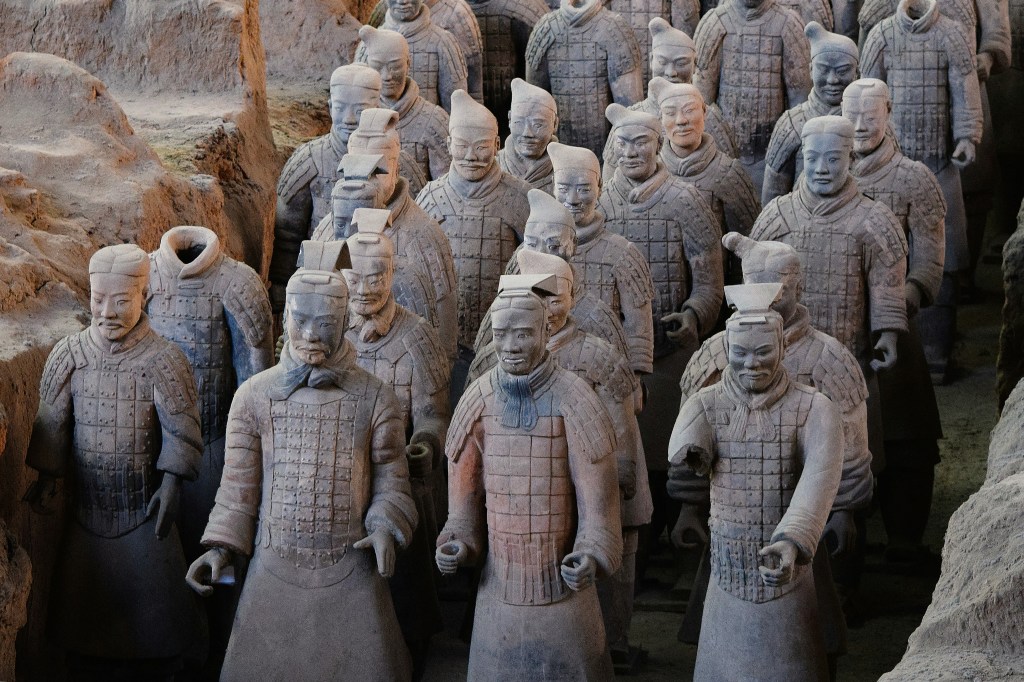
Fun fact: this was only accidentally discovered by farmers in 1974. That’s crazy—imagine uncovering something like that! Those farmers are probably still alive to tell the story.
Anyway, 11 years after becoming the first emperor of China, Qin Shi Huang died at the age of 49—potentially due to mercury poisoning. His life was dramatic, controversial, and absolutely crucial to the history of China. I don’t want this series to be too academic, but if you’re curious, there’s so much more to learn about him.
The Qin Dynasty collapsed just four years after Qin Shi Huang’s death and was replaced by the Han Dynasty, which would bring Confucianism to the forefront as the state philosophy. But I might talk about Buddhism in my next video instead.
Anyway, let me do some research and see what’s interesting to share. Please like and subscribe if you enjoyed the video. I’ll see you in my next one. Bye!


 YY Projects
Leave a reply to James Elkington Cancel reply